

The language, symbols and visual principles behind VERGARD.
A closer look at the thinking behind VERGARD—from the name and category to the Authority Shield, tone of voice and visual principles.
The Name
VER
The first part draws from the Latin verus, meaning true, and veritas, meaning truth, authenticity, and that which can be trusted.
This reflects the central question behind the product:
Is this voice, face, message, or command authentic?
GARD
The second part draws from the Old Norse garðr—an enclosed or fortified space, a protected boundary, or a stronghold.
It carries the idea of something valuable being placed inside a controlled perimeter.
VER + GARD
Together, the name can be understood as:
A stronghold for what is true.
Or, more specifically:
A protected boundary around authentic authority.
VERGARD does not merely detect whether a piece of media is synthetic.
It protects the boundary between a real executive and anyone attempting to speak, appear, or act with their authority.
Why the Name Fits the Brand
The name combines two sides of the product.
VER represents authenticity:
the real voice;
the real face;
the real command;
the legitimate source of authority.
GARD represents protection:
the boundary;
the shield;
controlled access;
the space an impersonator cannot enter.
This makes VERGARD more than a compressed version of “verify” and “guard.”
It describes the role of the brand:
To establish a protected perimeter around the identity people trust and the authority that identity carries.
Visuals
Visual Aesthetic
VERGARD was designed to feel calm, controlled and unmistakably protective.
Every visual element—from the ceramic mask to the typography and motion—reinforces the same idea: authority secured without noise.

A Visual Language of Silent Authority
VERGARD avoids the familiar visual clichés of cybersecurity. Black editorial space, ceramic white surfaces and restrained cyan signals make protection feel calm, intelligent and already in control.
Presence
Protected authority
taking form from darkness.
Awareness
A controlled presence responding before the threat becomes visible.

Brand essence
VERGARD protects authority in the AI age
Core idea
Your authority stays yours.
For years, cybersecurity focused on protecting systems, accounts, devices, and data. But deepfake technology introduced a different kind of threat.
An attacker no longer has to break into the system.
They can imitate the person who has the authority to use it.
A cloned voice can request a transfer.
A synthetic face can appear in a meeting.
A convincing message can trigger an executive decision.
The system may remain technically secure while the organisation still acts on a false command.
That became the starting point for the project.
The original problem
The initial concept focused on voice and deepfake protection.
At first, the problem appeared to be technical:
How can a company detect whether a voice, face, or message is real?
But that framing was too narrow.
The real business risk was not the fake voice itself.
The risk was what the voice could make other people do.
It could:
authorise a payment;
change a strategic decision;
create internal panic;
manipulate employees;
damage trust;
compromise the authority of a real executive.
This shifted the project from deepfake detection to a much larger question:
What happens when an attacker can act with the authority of a real person?
Category line
The armor of authority for the AI age.
Not just data.
Not just identity.
It protects a person’s right to remain the only legitimate source of their words, decisions, and commands.
Emotional territory
Controlled Confidence
Calm, composed, silent certainty.
VERGARD does not shout, dramatise, or try to appear more dangerous than the threat itself.
It creates the feeling that the threat has already been understood, calculated, and brought under control.


Tone of Voice
Precise | Calm | Restrained | Intelligent | Certain | Authoritative
The copy should sound like a warning from someone who has already checked every possibility — not a sales message trying to create fear.
Main Verbal Territories
Authority · Command · Trust · Proof · Identity · Control · Protection · Silence · Certainty · Armor
Core Phrases
You built the empire. Make sure you stay in command.
***
Decades to build. Seconds to lose.
***
Your face opens doors. Your voice moves millions. VERGARD protects both.
***
Your legacy is real. Ensure your voice is too.
***
Authority needs a new kind of protection.
***
Your systems may be secure. Your authority may not be.
Logo Construction
Protection Built Into the Mark


Instead of placing a generic security icon beside the name, the idea of protection was embedded directly into the identity itself.


Protection was not added to the logo. It became the logo.
The Strategic Reframe
From identity protection to authority protection
Most security brands describe the problem through technology:
voice authentication;
biometric verification;
fraud detection;
deepfake analysis;
identity monitoring.
VERGARD reframed the same problem through business consequences.
The product is not only protecting a voice or a face.
It is protecting everything that depends on people believing that voice or face:
money;
decisions;
trust;
reputation;
command;
organisational control.
That led to the category definition:
Executive Authority Protection
This became the foundation of the brand.
VERGARD protects the point where identity becomes action.
The core insight
A CEO’s identity is not valuable only because it belongs to them.
It is valuable because other people respond to it.
Their voice can move money.
Their face can validate a meeting.
Their message can change the direction of a company.
This means executive identity is no longer just a personal asset.
It is part of the company’s operational infrastructure.
The core insight became:
When identity can move money, people, or decisions, identity becomes an attack surface.
VERGARD exists to protect that surface.
The Central Metaphor
Authority has always required protection
For centuries, power was protected physically.
Rulers, commanders, and decision-makers were surrounded by:
armor;
shields;
guards;
walls;
controlled access.
The purpose was not simply to protect the person.
It was to protect the continuity of command.
In the AI age, the threat has changed.
Authority can now be attacked without physically reaching the person.
A voice can be cloned.
A face can be recreated.
A command can be fabricated.
The old armor no longer protects the surface that matters.
That led to the central metaphor:
The armor of authority for the AI age.
VERGARD is not presented as another cybersecurity platform.
It is presented as the modern armor protecting the voice, face, decisions, and trust behind executive authority.
Threat Stories Built to Convert
Real-world deepfake cases transformed into narrative event experiences— from emotional engagement to a personalised exposure assessment.
THREAT STORY 01
THE HONG KONG CALL

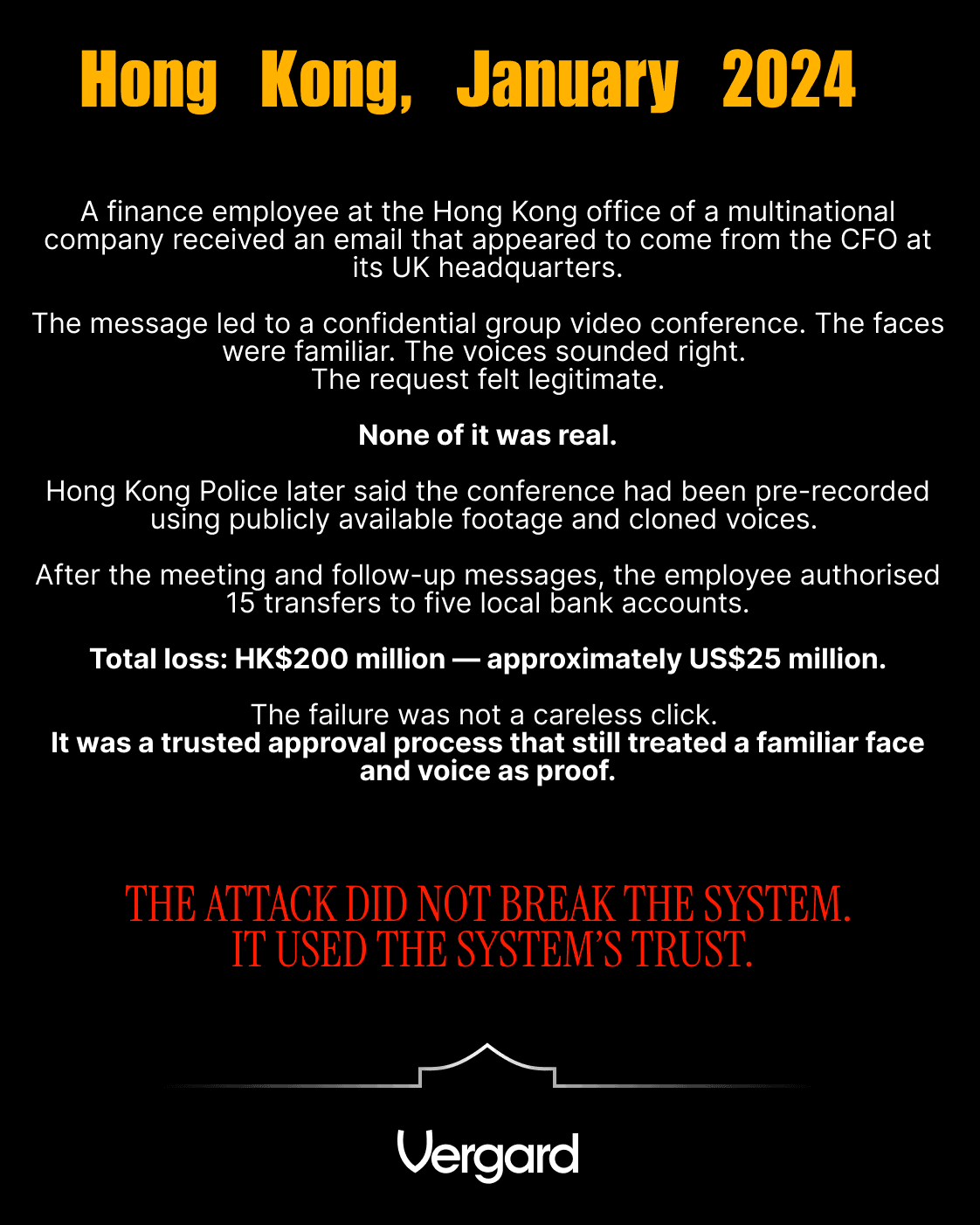





GTM Assets

LinkedIn Content · Email Outreach · Exposure Assessment